Charon: Moon of Pluto

A darkened and mysterious north polar region known to some as Mordor Macula caps this premier view of Charon, Pluto’s largest moon. The high-resolution image was captured by the interplanetary space probe New Horizons near its closest approach to distant Pluto on July 14, 2015. The combined blue, red, and infrared image data was processed to enhance colors and follow variations in Charon’s surface properties with a resolution of about 2.9 kilometers (1.8 miles). A stunning image of Charon’s Pluto-facing hemisphere, it also features a clear view of an apparently moon-girdling belt of fractures and canyons that seems to separate smooth southern plains from varied northern terrain. Charon is 1,214 kilometers (754 miles) across. That’s about 1/10th the size of planet Earth but a whopping 1/2 the diameter of Pluto itself, and makes it the largest satellite relative to its parent body in the Solar System. Still, the moon appears as a small bump at about the 1 o’clock position on Pluto’s disk in the grainy, negative, telescopic picture inset at upper left. That image was used by James Christy and Robert Harrington at the U.S. Naval Observatory in Flagstaff to discover Charon in June of 1978.

The Hydra Cluster of Galaxies

Within our own Milky Way galaxy, two bright, spiky stars stand like sentinels in the foreground of this cosmic snapshot. Far beyond them are the galaxies of the Hydra Cluster. In fact, while the spiky foreground stars are hundreds of light-years distant, the Hydra Cluster galaxies are well over 100 million light-years away. Three large galaxies near the cluster center, two yellow ellipticals (NGC 3311, NGC 3309) and one prominent blue spiral (NGC 3312), are the dominant galaxies, each about 150,000 light-years in diameter. An intriguing overlapping galaxy pair cataloged as NGC 3314 lies above and left of NGC 3312. Also known as Abell 1060, the Hydra galaxy cluster is one of three large galaxy clusters within 200 million light-years of the Milky Way. In the nearby universe, galaxies are gravitationally bound into clusters which themselves are loosely bound into superclusters. Superclusters in turn are seen to align over even larger scales.

The Vela Supernova Remnant

The explosion is over, but the consequences continue. About twelve thousand years ago, a relatively normal star in the constellation Vela suddenly exploded, creating a strange point of light briefly visible to humans living near the beginning of recorded history. The outer layers of the star crashed into the interstellar medium, driving a shock wave that is still visible today. The featured image, taken piecemeal over 60 hours from the Khomas Region of Namibia, captures some of that filamentary and gigantic shock in visible light, with details highlighted by hydrogen (red) and oxygen (blue) emissions. As gas flies away from the detonated star, it decays and reacts with the interstellar medium, producing light in many different colors and energy bands. Remaining at the center of the Vela Supernova Remnant is a pulsar, a star as dense as nuclear matter that spins around more than ten times in a single second. Explore the Universe: Random APOD Generator

Messier 104

A gorgeous spiral galaxy, Messier 104 is famous for its nearly edge-on profile featuring a broad ring of obscuring dust lanes. Seen in silhouette against an extensive central bulge of stars, the swath of cosmic dust lends a broad brimmed hat-like appearance to the galaxy suggesting a more popular moniker, the Sombrero Galaxy. Also known as NGC 4594, the Sombrero galaxy can be seen across the spectrum and is host to a central supermassive black hole. About 50,000 light-years across and 28 million light-years away, M104 is one of the largest galaxies at the southern edge of the Virgo Galaxy Cluster. Still, the spiky foreground stars in this field of view lie well within our own Milky Way. This broad view of the well-known galaxy was processed to reveal M104’s extended halo, as well as a faint tidal stellar stream. It was captured by the Dark Energy Camera (DECam) on the Blanco 4-meter telescope at the Cerro Tololo Inter-American Observatory.

NGC 1514: The Crystal Ball Nebula

What do you see in this crystal ball? The featured image shows NGC 1514, known as the Crystal Ball Nebula, observed by the Gemini North telescope on Maunakea, in Hawai’i. NGC 1514 is 1,500 light-years away and was discovered by William Herschel in 1790. This planetary nebula is formed when a star becomes a red giant and ejects its outer gas layers. The ejected shell of gas is heated up by the core of the star to temperatures hotter than the surface of our Sun: that makes the gas shine, creating beautiful images like this one. The slightly asymmetrical shape of the Crystal Ball Nebula reveals a secret: the bright star in the center has a companion. As the two stars orbit each other with a period of about nine years, they shape the gas around them. In about 10,000 – 25,000 years the nebula will be dissipated by their stellar winds.

PK 164 +31.1: The Headphone Nebula

What is a pair of headphones doing in the sky? Today’s image features the Headphone Nebula, also known as PK 164 +31.1 or Jones-Emberson 1. This planetary nebula, the remnant of a dying Sun-like star, faintly occupies an angular region of the Lynx constellation about 1/5th the diameter of the full moon. The red and blue-ish green colors trace hydrogen and oxygen atoms, respectively, that have been excited and ionized by the nebula’s central white dwarf. The headphone shape, where two lobes of hydrogen puncture the inner region of oxygen, adds this object to a long list of oddly shaped nebulae. The morphology of such strange nebulae hint at the presence of a stellar or planetary companion, which can stir the material flowing out from the dying star. You can listen to Hubble and JWST sonifications of planetary nebulae through your very own headphones!

NGC 3660 and Burçin’s Galaxy

The upper galaxy might be more photogenic, but the lower galaxy is more unusual. The galaxy up top is NGC 3660, a spiral galaxy similar to our own Milky Way galaxy in that it has several bright blue spiral arms and a central bar of stars, dust, and gas. Captured by chance in the featured deep and colorful image, surprisingly, is SN 2026cff, a supernova found just to the right of the central bar. Farther in the distance is the bottom galaxy, known informally as Burçin’s galaxy, but formally cataloged as LEDA 1000714. The center of this galaxy appears to be an old elliptical galaxy, but it is strangely surrounded by not one but two rings of stars. What created Burçin’s galaxy is a mystery and remains a continuing topic of research, but it likely involves the accretion of one or more smaller galaxies.

Thackeray’s Globules

What are these strange space globs? Situated in rich star fields and glowing hydrogen gas, these opaque clouds of interstellar dust and gas are so large they might be able to form stars. Their home is known as IC 2944, a bright stellar nursery located about 7,600 light years away toward the constellation of the Centaur (Centaurus). The largest of these dark globules, first spotted by A. D. Thackeray in 1950 using a telescope in South Africa, is likely two separate but overlapping clouds, each more than one light-year wide. Along with other data, the featured Hubble palette image from the El Sauce Observatory in Chile, indicates that Thackeray’s globules are fractured and churning as a result of intense ultraviolet radiation from young, hot stars already energizing and heating the bright emission nebula. These and similar dark globules known to be associated with other star forming regions may ultimately be dissipated by their hostile environment — like cosmic lumps of butter in a hot frying pan. Interstellar Jigsaw: Astronomy Puzzle of the Day

Messier 2

After the Crab Nebula, this giant star cluster is the second entry in 18th century astronomer Charles Messier’s famous list of things that are not comets. M2 is one of the largest globular star clusters now known to roam the halo of our Milky Way galaxy. Though Messier originally described it as a nebula without stars, this stunning Hubble image resolves stars across the cluster’s central 40 light-years. Its population of stars numbers close to 150,000, concentrated within a total diameter of around 175 light-years. About 55,000 light-years distant toward the constellation Aquarius, this ancient denizen of the Milky Way, also known as NGC 7089, is 13 billion years old. An extended stellar debris stream, a signature of past gravitational tidal disruption, was recently found to be associated with Messier 2.

The Nebulous Realm of WR 134

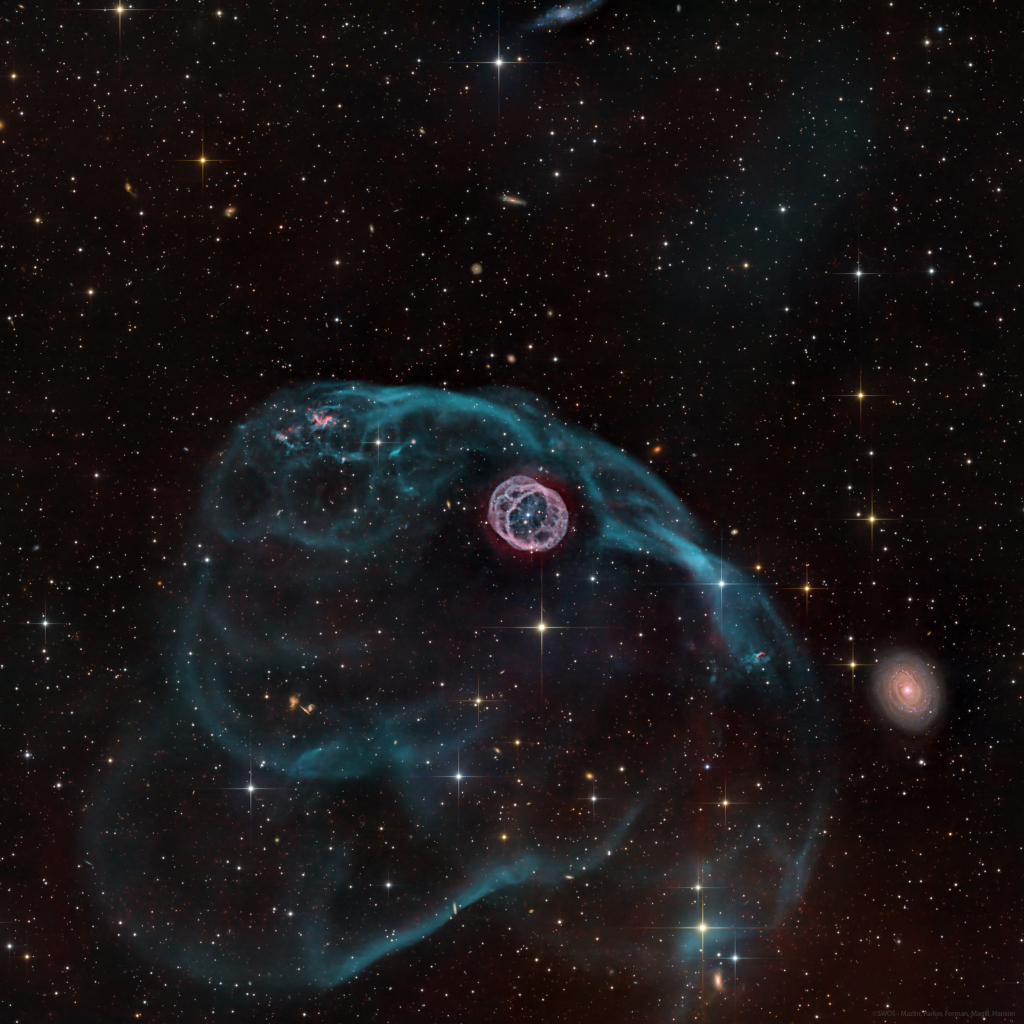
This cosmic snapshot covers a field of view over twice as wide as the full Moon within the boundaries of the high-flying constellation Cygnus. Made using astronomical narrowband filters, the image highlights the bright edge of a ring-like nebula traced by the glow of ionized hydrogen and oxygen gas. Embedded in the region’s expanse of interstellar clouds, the complex, glowing arcs are sections of shells of material swept up by the wind from Wolf-Rayet star WR 134, the brightest star near image center. Distance estimates put WR 134 about 6,000 light-years away, making this telescopic frame over 100 light-years across. Shedding their outer envelopes in powerful stellar winds, massive Wolf-Rayet stars have burned through their nuclear fuel at a prodigious rate and end their final phase of massive star evolution in a spectacular supernova. Their stellar winds and final supernova explosion enrich the interstellar material with heavy elements to be incorporated in future generations of stars.

© seanfarnon.com | © SPACEVOLVE.COM 2026